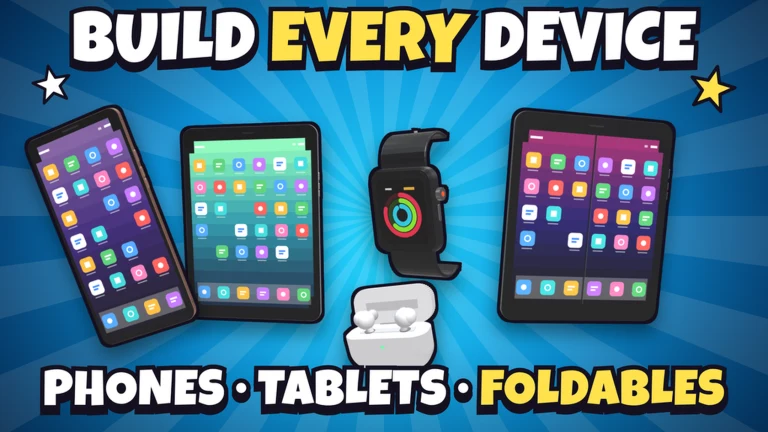
- Build a Phone Empire phone manufacturing starts in the garage with one balanced, repeatable phone design.
- Core loop: design a phone, price it above cost, launch it, then reinvest sales income into research and staff.
- Best early move: test demand with a low-cost build before spending cash on premium components or expansion.
- Research order: phones first, then tablets, watches, earbuds, and foldables as income stabilizes.
- Legacy system: selling your company grants permanent boosts that make every future run faster.
How Phone Manufacturing Works in Build a Phone Empire
Build a Phone Empire, developed by DEVTEC STUDIOS on Roblox, turns you into the founder of a phone company. Manufacturing sits at the heart of the experience: every phone you release combines design choices, production costs, pricing, and market demand into a single sales result. Since its launch on September 22, 2026, the game has drawn over 795K visits and a peak of 6.8K concurrent players, with roughly 76% positive ratings and 28 goals to complete.
The manufacturing cycle follows a clear pattern:
| Stage | Action | Output |
|---|---|---|
| Design | Pick screen, camera, shell, buttons, color, material, logo | A phone design with defined appeal and cost |
| Production | Commit cash to build the product | Inventory ready for launch |
| Pricing | Set a selling price | Profit margin per unit |
| Launch | Release with optional marketing | Sales, reviews, and income |
| Reinvest | Spend profits on research, staff, office | Faster, stronger next cycle |
The game saves automatically, but finish important actions like launches and hires before leaving a server. Progress tied to an unfinished action may not carry over cleanly.
Each pass through this loop should leave your company with more cash, more research, and a larger operation than the last. Players who treat the cycle as a repeatable system, rather than a one-time event, grow far faster than those chasing single expensive upgrades.
Phone Design: Parts and Tier Strategy
Every phone in Build a Phone Empire is built from seven visible design categories: screen, camera, shell, buttons, color, material, and logo. No single part decides success — what matters is how the whole package balances against production cost and the price your current market will accept.
| Tier | Stage | Design Focus | Key Risk |
|---|---|---|---|
| S | Late Game | High-end screen, camera, premium shell and material | High operating costs before demand is stable |
| A | Mid Game | Mid-range parts, broad-appeal color, standard material | Losing sales if priced near premium rivals |
| B | Early Game | Affordable parts, basic logo, simple color | Low ceiling on selling price |
| C | Any Stage | Most expensive option in every category | Weak margins and wasted cash if used too early |
Early Game: Low-Cost Starter
- Cheapest viable parts in every slot
- Lowers the loss if the first launch flops
- Ideal for testing price and demand
Mid Game: Balanced Sales Model
- Mid-range screen and camera
- Durable shell, functional buttons
- Leaves cash for staff and marketing
Late Game: Premium Flagship
- High-end everything
- Supports premium pricing at scale
- Requires stable demand and marketing first
Selecting the most expensive option in every category early produces low margins and drains the cash reserve needed for your next launch. Premium builds only pay off once demand, marketing, and regional reach support premium prices.
Step-by-Step: From Garage to First Launch
Follow this sequence to get your first phone manufactured and sold without burning your starting cash.
Start in the Garage
Learn where the design, production, staff, pricing, and launch interfaces are before spending anything. Map out the workspace so every later action is fast.
Design Your First Phone
Build a simple, balanced phone with affordable parts. Review the expected product result before committing — compatibility and cost matter more than flash.
Set a Sustainable Price
Price above part and production costs, but keep the phone accessible to your current market. Start conservative; adjust based on real sales data.
Hire Staff Carefully
Recruit employees only when business income can cover their ongoing cost. Each hire should measurably improve production or sales.
Launch, Save, Reinvest
Release the phone, monitor sales, and reinvest profits into the next product cycle. Keep a cash reserve for operations at all times.
If a phone sells fast but earns little, raise the price gradually. If sales stall, cut the price or improve the design before producing more units.
Research and Product Line Expansion
Research determines what your company can actually manufacture. The core phone path should come first because phone releases fund everything else. Once the phone line generates reliable income, adjacent categories become worth the investment.
| Product Line | Priority | When to Research |
|---|---|---|
| Phones | Highest | Immediately — the foundation of all revenue |
| Tablets | High | After phone operations are stable |
| Smartwatches | Medium | When cash and staff can handle extra releases |
| Earbuds | Medium | As a supporting line, not a replacement |
| Foldables | Situational | Only with strong research capacity and reserves |
| Laptops | Situational | During broad expansion, not a fresh run |
Prioritize technologies that unlock new products or strengthen your main revenue source. Optional product lines can wait until the core cycle is self-funding.
Game Passes such as a research accelerator or cash multiplier can speed this progression considerably for frequent players, while cosmetic passes only change appearance. Efficiency passes deserve priority on a limited Robux budget.
Money Management and Legacy Planning
Cash in Build a Phone Empire grows through the complete product cycle, not single upgrades. Money strategy breaks down into five ranked priorities:
| Priority | Strategy | Avoid |
|---|---|---|
| Highest | Build a repeatable product before expanding | Spending most cash on space while untested |
| High | Balance parts against production cost | Auto-picking the priciest option |
| High | Treat pricing as an experiment | Holding a high price despite weak demand |
| Medium | Add marketing and staff after sales are stable | Stacking ongoing costs too early |
| Medium | Expand regions once income is consistent | Expanding right after one good launch |
The Legacy system adds a long-term layer: selling your company starts a fresh run while keeping permanent Legacy bonuses. Time a reset after a productive development phase, not mid-bottleneck. Several well-timed resets compound into faster, larger companies than one endless first run.
Do not reset while your company still unlocks major improvements quickly. When progress slows to incremental gains, the permanent Legacy boost usually outvalues continued expansion.
Manufacturing Milestones:
- Design and launch your first profitable phone
- Complete design and hiring goals for cash rewards
- Unlock the tablet product line through research
- Establish a regular product release cycle
- Complete a well-timed Legacy reset for permanent boosts
FAQ
Q: What is the best first phone to manufacture in Build a Phone Empire?
A low-cost starter build with affordable parts in every category. It minimizes losses if demand is weak, lets you test pricing safely, and preserves cash for research and staff while you learn the market.
Q: Should I hire employees before my first launch?
Generally no. Fill positions only after the first product is profitable and income can cover ongoing salaries. Hiring too early stacks costs on top of an unproven product.
Q: Which research path should I unlock first?
The core phone research path. Phone releases establish your main revenue cycle and fund later technologies. Tablets, smartwatches, and earbuds should follow once income is stable.
Q: When should I sell my company through the Legacy system?
Sell after completing a productive development phase, once growth slows to incremental gains. The permanent Legacy bonus compounds across runs, making several well-timed resets more efficient than one very long first run.