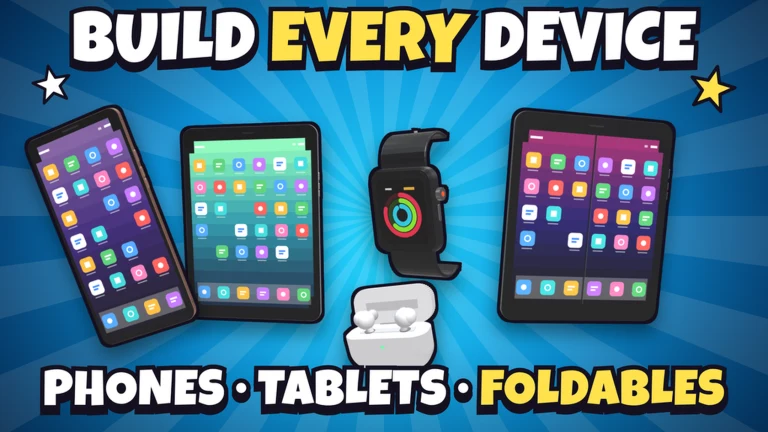
- Best phone build depends on your stage: budget starter, balanced mid-game, or premium flagship.
- Component balance: screen, camera, shell, color, material, and logo must match your price point.
- Pricing rule: test demand first, raise prices gradually, and never max every category early.
- Research first: strong phone research unlocks the revenue cycle that funds all later products.
- Reinvest: each launch should fund the next design, staff, and marketing upgrades.
Best Phone Build Overview
In Build a Phone Empire, the best phone build is not a single fixed combination of parts. A design is only strong when its screen, camera, shell, button, color, material, and logo choices match your current cash, research level, and market demand. A maxed-out phone built in the garage stage will drain your balance, while a cheap starter phone can be the most profitable build you ever make.
Every phone build should be judged against three questions:
| Question | What It Checks | Good Sign |
|---|---|---|
| Can I afford production? | Cash reserve after building | You keep funds for staff and marketing |
| Can it sell above cost? | Margin between price and parts | Price has room to absorb weak demand |
| Does it fit my stage? | Match between tier and progress | Early, mid, or late design matches income |
New players often select the most expensive option in every category. This creates low margins, weak demand, and little cash left for the next launch. Component quality only pays off when the phone can sell at a profitable price.
Phone Build Tier List
Use this tier list as a stage-based plan, then compare results with live sales data after each game update.
| Tier | Stage | Build Style | Best Use | Main Risk |
|---|---|---|---|---|
| S | Late Game | Balanced Premium Flagship | High prices with established marketing and regional reach | Very inefficient before cash flow is stable |
| A | Mid Game | Balanced Sales Model | Repeatable sales base, leaves cash for staff and marketing | Loses sales if priced too close to premium phones |
| B | Early Game | Low-Cost Starter Phone | Cheap testing of price and demand from the garage | Low ceiling, unsuitable for premium expansion |
| C | Any Stage | Unbalanced Maxed-Out Build | Testing the upper end of pricing when ready | High costs, weak demand, drained cash if used early |
S-Tier: Premium Flagship
- High-end screen and camera
- Premium shell, material, and logo
- Needs marketing and regions first
- Best when demand is proven
A-Tier: Balanced Sales Model
- Mid-range quality across categories
- Broad-appeal color and durable shell
- Funds employees and marketing
- Strongest all-around pick
B-Tier: Starter Phone
- Affordable parts in every slot
- Lowest risk first launch
- Ideal for price experiments
- Upgrade out of it quickly
Tiers are stage labels, not permanent rankings. A B-tier starter phone in the garage can out-earn an S-tier flagship if your market and marketing are not ready for premium pricing yet.
Component Priorities by Stage
Each design category contributes differently depending on where you are in a run. The table below shows where to spend first.
| Component | Early Game | Mid Game | Late Game |
|---|---|---|---|
| Screen | Affordable option | Mid-range quality | High-end option |
| Camera | Affordable option | Mid-range option | High-end option |
| Shell | Low-cost option | Durable, reasonably priced | Premium option |
| Button | Basic option | Functional option | Feature-focused option |
| Color | Simple broad-appeal | Broad-appeal | Marketable premium |
| Material | Low-cost standard | Standard quality | Premium material |
| Logo | Basic brand logo | Recognizable logo | Strong brand identity |
Upgrade the categories customers notice most, screen and camera, before spending on premium buttons or luxury materials. Perceived quality drives price tolerance more than hidden component cost.
Pricing and Launch Strategy
A great phone build can still fail with the wrong price. Treat every launch as an experiment: release, observe, adjust, and only then scale production and marketing.
Cost the Build
Add up every part and production cost before launch. Your price must sit comfortably above this number so weak demand does not turn into a loss.
Launch Conservatively
Start with a moderate price. A phone that sells quickly at thin profit tells you demand exists; you can raise the price gradually on the next run.
Read the Market
If sales are weak, lower the price or improve the design before producing more. Never keep an expensive price after the market rejects it.
Add Staff and Marketing
Only bring in marketing and employees after the core product already sells well enough to cover the extra cost. They scale a working cycle, they do not create one.
Reinvest With a Reserve
Put launch profits into the next build, research, or expansion, but keep a cash reserve so operations never stall between products.
Paying for multiple ongoing costs, staff plus marketing, before confirming regular sales is the fastest way to run a young company into the ground.
Research Support for Your Build
Your best phone build is limited by research. The core phone research path should come before tablets, smartwatches, earbuds, foldables, or laptops, because phone releases establish the revenue cycle that funds everything else.
| Product Line | Priority | When to Research |
|---|---|---|
| Phones | Highest | First, from the start of every run |
| Tablets | High | After phone operations are stable |
| Smartwatches | Medium | When cash and staff can handle extra lines |
| Earbuds | Medium | As a supporting line, not a replacement |
| Foldables | Situational | Advanced branch, needs research capacity |
| Laptops | Situational | During broad expansion phases |
Selling your company through the Legacy system grants permanent boosts. Well-timed resets let each new run reach stronger phone builds faster than one very long first run.
Best Build Milestones:
- Launch a profitable B-tier starter phone
- Complete core phone research path
- Move to an A-tier balanced sales model
- Hire staff only after stable sales
- Reach an S-tier flagship with marketing and regions
FAQ
Q: What is the best phone build in Build a Phone Empire?
There is no single best build for every situation. The A-tier Balanced Sales Model is the strongest all-around choice for most players, while the S-tier Premium Flagship becomes the best option late in a run once marketing, regions, and cash flow are established.
Q: Should I use the most expensive parts on my first phone?
No. Maxing every category early creates high costs, low margins, and weak demand. Use affordable parts for your first launch so you can test pricing and demand with minimal risk, then upgrade as income grows.
Q: How do I know if my phone price is right?
Watch sales after launch. If the phone sells fast but profit is thin, raise the price gradually. If sales are weak, lower the price or improve the design before producing more units.
Q: When should I research products other than phones?
Finish the core phone research path first. Add tablets once phone operations are stable, then smartwatches and earbuds as supporting lines. Foldables and laptops fit best during a broader expansion phase.