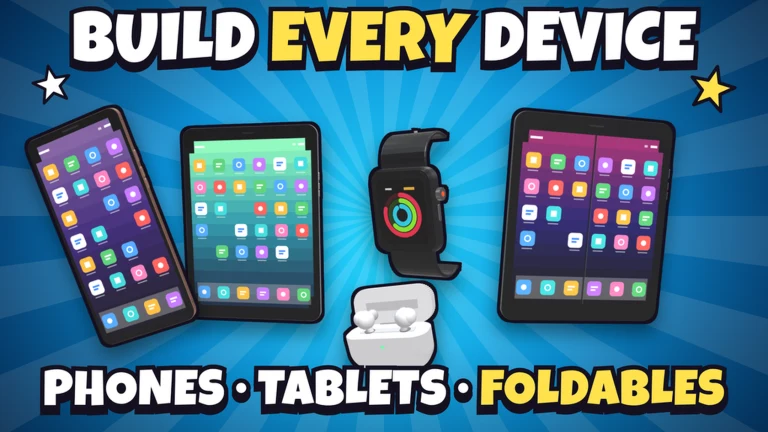
- Build a Phone Empire best strategy: complete one profitable product cycle before expanding anything else.
- Early game: low-cost phone design, conservative pricing, no premature hiring.
- Mid game: balanced mid-tier designs, staff, marketing, first regional expansion.
- Late game: premium flagship line, tablets and wearables, timed Legacy resets.
- Golden rule: reinvest only after current products generate dependable income.
Core Strategy: The Product Cycle First
The best Build a Phone Empire strategy centers on a simple loop: design a phone, price it above cost, launch it, watch demand, and reinvest the profit. Players who spend starting cash on office expansion or premium components before their first product sells reliably almost always stall. Treat every run as a business simulation — cash reserves buy flexibility, and flexibility compounds.
The game, developed by DEVTEC STUDIOS and released on September 22, 2026, rewards players who strengthen the complete product cycle rather than chasing one expensive upgrade. The official Roblox game page confirms the core loop: design phones, build offices, hire staff, research technology, and launch products.
| Strategy Pillar | What It Means | Priority |
|---|---|---|
| Product cycle | Design, price, launch, reinvest | Highest |
| Cost control | Keep cash reserve above operating costs | High |
| Demand testing | Adjust price based on sales data | High |
| Staff and marketing | Add only after stable sales | Medium |
| Regional expansion | Fund from consistent profits | Medium |
If your first phone barely sells, do not produce more of it. Cut the price or improve the design first — a weak-demand product at scale multiplies your losses.
Early Game: From Garage to First Profit
Start in the garage. Learn where the design interface, parts categories, launch controls, and sales tracking are located before committing a single dollar to expansion. Your first phone should be a low-cost starter design: affordable screen, affordable camera, basic shell, broad-appeal color, and standard material.
Set Up in the Garage
Locate the phone design interface, parts and customization categories, and where launches and sales are tracked. Commit no cash to expansion yet.
Design a Cheap, Balanced Phone
Pick affordable components across screen, camera, shell, button, color, material, and logo. Never spend the whole starting balance on premium options.
Price Conservatively
Account for parts and production costs, leave cash for operations, and lower the price immediately if demand is weak.
Hire Only When Stable
Compare each employee's cost against expected income. Do not fill every position before your first product is profitable.
Launch, Save, Reinvest
Release the phone, review sales and cash, then reinvest in improvements that directly support the next product. Keep a reserve at all times.
Spending most of your balance on office space or premium parts while your first product is still untested is the fastest way to stall a run. Build the product before expanding.
Phone Design Strategy by Stage
Design strength depends on more than one component. Evaluate screen, camera, shell, button, color, material, and logo together with price, demand, marketing, and production cost. Match your design tier to your current stage of the run.
Early: Low-Cost Starter
- Low starting cash requirement
- Easy to test pricing and demand
- Limits premium expansion later
Mid: Balanced Sales Model
- Best appeal-to-cost ratio
- Supports repeat sales and staff costs
- Weak if priced near premium phones
Late: Premium Flagship
- Supports high selling prices
- Strong brand identity
- Inefficient before demand is stable
| Design Element | Early Game | Mid Game | Late Game |
|---|---|---|---|
| Screen | Affordable option | Mid-range quality | High-end option |
| Camera | Affordable option | Mid-range option | High-end option |
| Shell | Low-cost | Durable, reasonable price | Premium |
| Material | Standard low-cost | Standard quality | Premium material |
| Logo | Basic brand logo | Recognizable logo | Brand-focused logo |
| Target price | Low margin, high volume | Balanced | High margin |
Filling every category with the most expensive option early creates low margins, weak demand, and no cash for future launches. Premium builds only pay off when the market and your cash flow are ready.
Research Order and Expansion Timing
Research determines which products your company can design and release. Start with the core phone path, then expand into adjacent categories as income and research capacity grow.
| Product Line | Unlock Focus | Priority | Planning Note |
|---|---|---|---|
| Phones | Core path first | Highest | Funds the entire revenue cycle |
| Tablets | After stable phone ops | High | Do not slow main phone development |
| Smartwatches | Connected-device branch | Medium | Add with enough cash and staff |
| Earbuds | Accessory branch | Medium | Supporting line, not a priority |
| Foldables | Advanced phone branch | Situational | Needs research capacity and reserves |
| Laptops | Late research options | Situational | Broad expansion phase only |
Prioritize technologies that unlock new products or improve your main revenue source. Optional product lines should never delay stronger phone and tablet research.
For regional expansion, the same discipline applies: expand only after consistent product performance and a healthy cash reserve. A single successful launch is not proof of stability.
Legacy Resets and Long-Term Growth
The Legacy system lets you sell your company and restart while keeping permanent boosts that improve future runs. The best strategy treats resets as compounding investments — several well-timed resets can outperform one very long first run.
| Signal | Action |
|---|---|
| Company still unlocking major improvements quickly | Keep expanding |
| Progress slowing to incremental gains | Consider Legacy reset |
| Basic income cycle not yet established | Never reset |
| Just finished a productive phase | Good reset breakpoint |
Strategy Milestones Per Run:
- Launch a profitable low-cost starter phone
- Establish stable cash flow before hiring
- Complete core phone research path
- Add balanced mid-tier design line
- Expand into one new region with reserves
- Reset via Legacy at a deliberate breakpoint
Choose a reset point after completing a productive development phase, not during an upgrade bottleneck. Each new run should have a clear improvement target — faster research, earlier expansion, or more efficient growth.
FAQ
Q: What is the best Build a Phone Empire strategy for brand-new players?
Focus on one reliable product cycle: design a cheap, balanced phone in the garage, price it conservatively, launch it, and reinvest the profit. Avoid expansion, premium parts, and full staffing until the first product sells dependably.
Q: When should I hire employees?
Hire only when your business income can support the ongoing cost and the staff clearly improves your production or sales cycle. Filling every position before your first profitable launch is a common early mistake.
Q: How do I price my phones correctly?
Treat pricing as an experiment. If a phone sells quickly but profit is thin, raise the price gradually. If sales are weak, lower the price or improve the design before producing more units.
Q: When is the right time for a Legacy reset?
Reset when your current company's growth slows to incremental gains and you have completed a productive development phase. Never reset while the basic income cycle is still unstable, and use the permanent Legacy boost to rebuild faster each run.