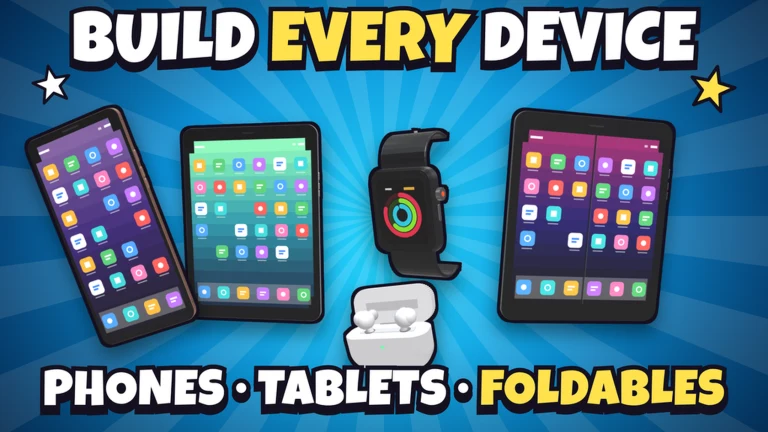
- Build a Phone Empire phone models span six product lines: phones, tablets, smartwatches, earbuds, foldables, and laptops.
- Research order matters: core phone research should come before any accessory line.
- Stage-based designs win: cheap starter phones, balanced mid-game models, and premium flagships each fit a different phase.
- Price against demand: test pricing on every model before committing premium parts.
- Avoid maxing parts early: unbalanced builds create weak margins and stalled cash flow.
Build a Phone Empire Phone Models Overview
In Build a Phone Empire, phone models are the heart of your company. Every model you design combines seven component categories — screen, camera, shell, button, color, material, and logo — and the combination you choose, along with price and marketing, determines how the product sells. Beyond phones, the research tree unlocks additional device lines that diversify your catalog and open new revenue streams.
The game, developed by DEVTEC STUDIOS and released on Roblox on September 22, 2026, structures progression around a core loop: design a device, produce it, launch it, watch sales, and reinvest. Phone models built early fund everything that follows, so understanding which models to build at each stage is the single most important skill in the game.
The six product lines and their general unlock flow look like this:
| Product Line | Unlock Focus | Priority | Best Stage |
|---|---|---|---|
| Phones | Core research path, foundation of company growth | Highest | Start |
| Tablets | Adjacent line after stable phone operation | High | Mid game |
| Smartwatches | Connected-device branch after reliable income | Medium | Mid game |
| Earbuds | Accessory branch for diversification | Medium | Mid-late |
| Foldables | Advanced phone research branch | Situational | Late game |
| Laptops | Later research options | Situational | Late game |
Phone releases establish your main revenue cycle and fund every later technology. Do not divert research into earbuds or foldables before your phone line generates consistent income.
Phone Model Tier List by Growth Stage
Model strength depends on context: cash on hand, market demand, and your ability to support premium production costs. This tier list groups model archetypes by development stage rather than ranking raw component stats.
| Tier | Stage | Model Archetype | Key Strengths | Main Risk |
|---|---|---|---|---|
| S | Late Game | Balanced Premium Flagship | Supports high prices, strong brand identity | Inefficient before demand and cash flow stabilize |
| A | Mid Game | Balanced Sales Model | Balances appeal and cost, repeatable sales | Can lose sales if priced near premium models |
| B | Early Game | Low-Cost Starter Phone | Low starting cash, easy price testing | Limited ceiling, weak premium expansion |
| C | Any Stage | Unbalanced Maxed-Out Build | High ceiling when market is ready | Low margins, weak demand, drained cash if rushed |
Each archetype maps to a specific component strategy:
S-Tier: Premium Flagship
- Screen/Camera: High-end options
- Shell/Material: Premium tier
- Color: Marketable premium color
- Logo: Strong brand-focused logo
- Works with established marketing and regional reach
A-Tier: Balanced Sales Model
- Screen: Mid-range, quality-focused
- Camera: Mid-range option
- Shell: Durable, reasonably priced
- Color: Broad-appeal color
- Leaves cash for employees and marketing
B-Tier: Low-Cost Starter
- Screen/Camera: Affordable options
- Shell/Button: Low-cost, basic
- Material: Standard low-cost material
- Reduces losses from an unsuccessful first launch
C-Tier: Maxed-Out Build
- All categories set to most expensive options
- Useful only for testing upper price limits
- Poor value early; high costs crush margins
Selecting the most expensive option in every category feels powerful but usually produces low margins and weak demand when your market presence is small. Match component quality to what your sales actually support.
Step-by-Step: Designing Your Next Phone Model
A reliable design workflow keeps each model aligned with your current stage and budget. Follow this process for every new phone you release.
Match Components to Your Stage
Review your cash reserve and recent sales. Early companies should choose affordable screens, cameras, and shells; mid-game companies can shift to mid-range quality options with broad-appeal colors.
Build a Coherent Design
Combine screen, camera, shell, button, color, material, and logo into one consistent product identity. A recognizable general-purpose logo outperforms mismatched premium parts on a budget model.
Cost the Model Before Launch
Account for every part and production cost. Confirm the model can sell above its total cost with room for profit while leaving cash available for operations.
Test Price and Demand
Treat pricing as an experiment. If the model sells fast with thin profit, raise the price gradually; if sales stall, cut the price or improve the design before producing more units.
Reinvest in the Next Model
Route profits into the component upgrades or research that directly support your next release, and keep a cash reserve for operating costs.
Always preview the expected product result before releasing. A final check on component pairing and price catches expensive mistakes that are slow to fix after launch.
Device Line Expansion Strategy
Once your phone models sell reliably, expansion into other device lines multiplies revenue — but only if timed well. Each additional line adds design work, research costs, and staff demands.
| Decision Point | Expand | Wait |
|---|---|---|
| Phone income | Consistent across multiple releases | Single successful launch |
| Cash reserve | Covers new line costs plus operations | Thin buffer |
| Staff capacity | Team can manage extra design work | Every position already stretched |
| Research | Core phone path complete or near-complete | Phone path still mid-progress |
| Market reach | Regions generating steady sales | Home market only |
Earbuds deserve special caution: treat them as a supporting product line, not a reason to delay stronger phone and tablet research. Foldables and laptops shine during broad expansion phases, when research capacity and cash reserves can absorb advanced product development.
Marketing and staff strengthen a model that already sells — they cannot rescue a bad design. Add ongoing costs only after the core product covers them comfortably.
Model Development Checklist
Track your phone model progression with this checklist. Each milestone confirms your company is ready for the next design tier.
Phone Model Milestones:
- Launch a low-cost starter phone from the garage
- Find a price point with steady demand and profit
- Shift to a balanced mid-game sales model
- Fund tablet research from phone revenue
- Release a premium flagship with marketing support
Remember that goals in the game — design, hiring, research, release, and expansion categories — pay cash rewards. Completing model milestones advances both your business and the reward track at the same time, so check the goals panel regularly to avoid leaving rewards unclaimed.
If model development progress slows despite solid operations, compare continued expansion against selling the company through the Legacy system. Permanent Legacy boosts can make every future phone model develop faster than the current run allows.
Phone Models FAQ
Q: What are the main Build a Phone Empire phone models I can build?
Phone models are custom designs built from seven component categories: screen, camera, shell, button, color, material, and logo. Beyond phones, the research tree unlocks tablets, smartwatches, earbuds, foldables, and laptops as additional device lines.
Q: Should I use the most expensive parts on my first phone?
No. A low-cost starter phone with affordable components requires less starting cash, makes pricing and demand easier to test, and reduces losses if the first launch underperforms. Premium parts only pay off once demand and cash flow are stable.
Q: When should I research non-phone device lines?
Research tablets after your phone operation is stable, add smartwatches and earbuds once core products generate reliable income, and save foldables and laptops for a broad expansion phase when research capacity and cash reserves can support them.
Q: How do I know if my phone model is priced correctly?
Watch sales performance. Quick sales with thin profit suggest raising the price gradually; weak sales suggest lowering the price or improving the design before producing more units. Treat every launch as a pricing experiment.